

Article
The Pressure to Fit In: Are We Losing Ourselves to Be Accepted?

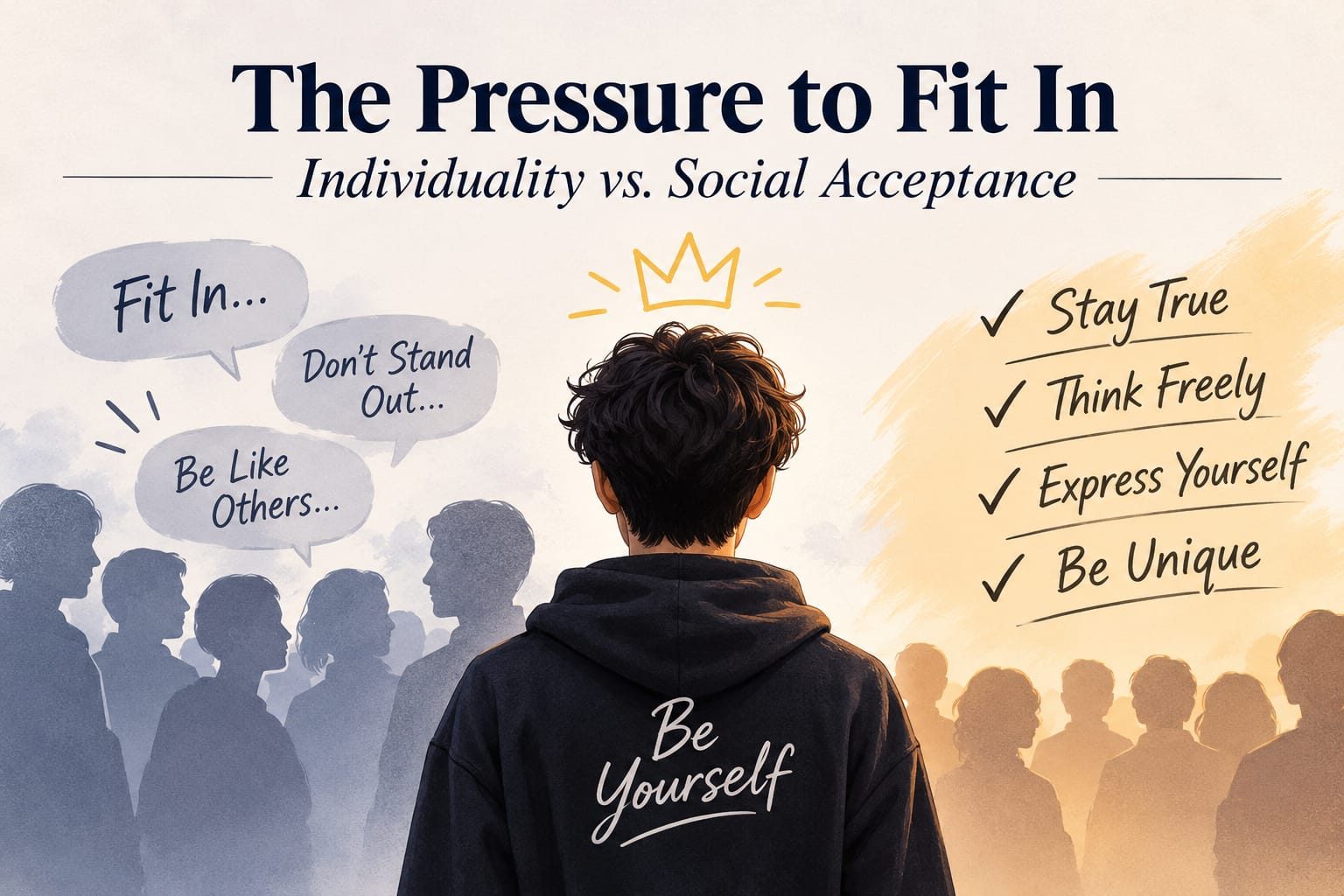
I surveyed 20 undergraduate science students across five institutions to explore the tension between individuality and social acceptance. The findings reveal a subtle contradiction: although many students occasionally suppress their opinions to avoid conflict, most still believe they maintain their individuality.
We spend years discovering who we are: developing our opinions, building our personalities, forming our values, and identifying what matters to us. Yet, when we enter a social environment, we sometimes begin adjusting those very things to feel accepted.
It happens in ordinary conversations. We hesitate before expressing an unpopular opinion. We laugh along when something does not genuinely amuse us. We avoid disagreement because maintaining harmony seems easier than explaining our perspective.
Nobody explicitly asks us to change. Nobody necessarily forces us to become someone else. Yet, somewhere between friendship, social expectations, and the desire to belong, we begin negotiating our individuality.
But where does healthy adaptation end, and self-compromise begin?
I wanted to explore this question beyond personal observation. So, I conducted a questionnaire-based study titled The Pressure to Fit In: Individuality vs. Social Acceptance, involving undergraduate science students from five institutions.
The findings revealed something more interesting than I initially expected: perhaps we are not necessarily losing ourselves. Perhaps we are becoming selective about which parts of ourselves we reveal.
The Most Common Compromise Is Silence
One of the clearest findings concerned something surprisingly ordinary: remaining silent when disagreeing with friends.
13 out of 20 respondents (65%) agreed or strongly agreed that they sometimes remain silent when they disagree with their friends.
Furthermore, 12 respondents (60%) acknowledged that they sometimes avoid disagreeing with others to prevent social conflict.
Consider another finding: when asked directly whether they had ever agreed with a group despite privately holding a different opinion:
5 (25%) said frequently.
6 (30%) said sometimes.
7 (35%) said rarely.
Only 2 (10%) said never.
In other words, 18 out of 20 respondents (90%) had experienced this situation at least occasionally.
Think about that for a moment.
You are sitting among friends. A discussion begins, and everyone seems to share the same perspective. You disagree, but instead of expressing your thoughts, you remain silent.
Did you change your opinion? Not necessarily.
Did you compromise your individuality? Perhaps not entirely.
But you did compromise its expression.
This distinction matters. Conformity does not always mean changing what we believe. Sometimes, it means learning when not to reveal what we believe.
And when silence becomes habitual, we should ask ourselves whether we are choosing it freely or allowing the fear of judgment to choose for us.
The Interesting Paradox: We Still Want to Be Ourselves
Despite these indications of conformity, the findings were not entirely pessimistic.
In fact, several responses suggested that students generally retain a strong sense of individuality.
15 out of 20 respondents (75%) agreed or strongly agreed that their actions generally reflect their genuine beliefs and values.
Similarly:
13 (65%) felt comfortable being themselves around university peers.
13 (65%) believed they could express genuine opinions even when they differed from others.
14 (70%) believed they could maintain their individuality without constantly seeking approval.
Perhaps the most interesting finding was that 14 respondents (70%) disagreed or strongly disagreed with the statement that they often felt they were not being true to themselves around their peers.
This creates an interesting paradox.
Students may occasionally hide their opinions, avoid confrontation, or adjust their behavior. Yet, they do not necessarily perceive themselves as having abandoned their identities.
Perhaps there is a difference between knowing who we are and feeling comfortable showing it.
We can remain confident in our beliefs while choosing not to express them in every environment.
The real question is: how often does that choice remain ours?
What Are We Actually Afraid Of?
When asked which areas university students most commonly compromise, personal opinions emerged as the most frequently selected answer.
The responses were:
Personal opinions: 8 selections (40%).
Personal values and beliefs: 7 (35%).
Lifestyle and behavior: 5 (25%).
Academic and career choices: 5 (25%).
Hobbies and interests: 4 (20%).
Social and cultural preferences: 3 (15%).
Clothing and appearance: 3 (15%).
Note: Participants could select up to two options, so these percentages are based on 20 respondents and do not add up to 100%.
The reasons were equally revealing.
When asked to identify the primary reason students compromise their individuality:
Reason| Responses
Fear of criticism or judgment| 6 (30%)
Lack of self-confidence| 4 (20%)
Peer pressure| 4 (20%)
Fear of social rejection| 3 (15%)
Desire for popularity| 2 (10%)
Desire to maintain friendships| 1 (5%)
Fear of criticism or judgment emerged as the leading explanation.
Interestingly, the desire for popularity was not the dominant reason.
Perhaps people are not always trying to become popular. Sometimes, they simply do not want to become unacceptable.
There is a difference between wanting everyone to admire us and wanting people to respect us without constantly questioning our differences.
Sometimes, the fear of losing that respect influences our behavior more than we realize.
Belonging or Fitting In: Are They Really the Same?
Consider two different environments.
In one, you are accepted as long as your opinions, interests, and behaviour remain reasonably aligned with everyone else's. You gradually adjust yourself to avoid becoming the odd one out.
In the other, people may disagree with you, enjoy different things, and have completely different perspectives, yet still respect your individuality.
Both environments offer social interaction. But they do not offer the same experience.
Fitting in often means adjusting yourself to meet the expectations of a group. Belonging, ideally, means being accepted without having to erase your differences.
I also asked participants whether someone could genuinely belong to a social group without compromising their individuality.
Fourteen respondents provided an answer to this open-ended question. Thirteen expressed agreement, while one disagreed.
However, their explanations were particularly interesting.
One respondent explained that genuine belonging depends on finding people whose thoughts, values, and interests allow everyone to express themselves freely.
Another suggested that although belonging without compromising individuality is possible, it depends heavily on the particular social group.
A contrasting response highlighted how people may face exclusion when they refuse to behave according to group expectations.
One respondent offered a particularly thoughtful perspective: sometimes, we have to choose our battles. Remaining silent does not always mean agreeing with someone. It can simply be a conscious decision to maintain a relationship while recognizing that not every disagreement needs to be expressed.
That perspective adds an important dimension to the discussion.
Perhaps belonging is not experienced in the same way by everyone. Some people find communities where their differences are welcomed, while others may have experienced social environments in which acceptance comes with conditions.
Maybe the challenge is not simply finding a group. It is finding an environment where individuality does not become a liability.
Are We Choosing Our Futures or Following Someone Else's?
The pressure to fit in does not always concern conversations, friendships, or personal preferences. Sometimes, it influences decisions that shape our futures.
University students are constantly exposed to different definitions of success. Some admire research, others entrepreneurship, financial stability, prestigious careers, or opportunities abroad.
Being surrounded by ambitious people can be inspiring. But it can also make us question our own direction.
The questionnaire explored whether students had considered changing their academic or career interests to align with what their peers considered prestigious.
Interestingly, 16 out of 20 respondents (80%) disagreed or strongly disagreed that they had considered changing their academic or career interests to match what their peers considered prestigious.
The same number (80%) disagreed or strongly disagreed that they felt pressured to pursue a career path similar to their friends despite preferring another direction.
Only one respondent (5%) agreed with the first statement, while three (15%) agreed with the second.
These findings suggest that, within this sample, academic and career conformity was less prominent than the suppression of opinions.
That is encouraging. However, there is an important distinction between inspiration and imitation.
Learning from someone's journey can help us grow. Feeling obligated to follow that journey simply because others admire it is something entirely different.
Our ambitions should be informed by our surroundings, not dictated by them.
Is Silence Always a Sign of Weakness?
There is another side to this discussion that deserves attention.
Not every disagreement needs to be expressed. Not every opinion deserves an argument. And not every situation requires us to defend our individuality.
Sometimes, silence is wisdom. Sometimes, compromise is maturity. Sometimes, maintaining a relationship matters more than proving a point.
Individuality does not mean disagreeing with everyone, just as authenticity does not mean expressing every thought without considering its consequences.
The important distinction is between choosing silence and being silenced by fear.
There is a difference between not wanting to argue and being afraid to speak.
One reflects personal choice. The other may reflect social pressure.
Interestingly, 13 respondents (65%) disagreed or strongly disagreed that expressing their genuine opinions could negatively affect their friendships.
Similarly, 13 (65%) disagreed or strongly disagreed that being excluded from a group affected their confidence.
These findings suggest that many participants do not necessarily view social acceptance as more important than their personal identity.
Yet, the fact that 65% sometimes remain silent during disagreements tells us that confidence in one's identity does not always translate into expressing it.
Perhaps We Don't Need to Change Less. We Need to Choose Better.
Growing as an individual inevitably involves change.
We learn from people around us, reconsider our assumptions, develop new interests, and sometimes abandon beliefs we once held strongly.
That is not necessarily a loss of identity. It is part of intellectual and personal development.
The problem begins when change stops being a conscious decision and becomes a requirement for acceptance.
We should be able to appreciate other perspectives without abandoning our own. We should be able to build meaningful relationships without pretending to be someone else.
Perhaps the goal is not to remain unchanged. It is to ensure that the person we become is someone we have consciously chosen to become.
A Question Worth Asking
This study draws on 20 consenting responses from undergraduate science students across five institutions, with 15 participants (75%) affiliated with PIEAS.
The responses included students from different academic years and disciplines. The study also explored personal experiences through open-ended questions, allowing participants to explain their perspectives beyond selecting predefined options.
The findings should be interpreted carefully. This is an exploratory study with a small, institutionally concentrated sample, not a representative account of all university students.
Nevertheless, it offers a starting point for a much broader conversation.
We all adapt. We all compromise. We all encounter situations where expressing every thought or preference may not be necessary.
But occasionally, we should pause and ask ourselves:
Are we becoming better versions of ourselves, or simply more acceptable versions of ourselves?
Perhaps real confidence is not the ability to stand apart from everyone.
It is the ability to stand among everyone without feeling compelled to become someone else.
Because belonging should give us a place in the world, not take away the person we are.
---
Participate in the Research
This article is informed by an exploratory study examining how social acceptance influences individuality and self-expression among undergraduate students.
If you are an undergraduate student and the questionnaire is still open, I invite you to share your perspective.
"Participate in the Survey – The Pressure to Fit In" (https://docs.google.com/forms/d/e/1FAIpQLSeW521lIHhRhrAN7a66Iizc6yDiEJwijC7v4LjejJyvJF82kw/viewform)
Your response can contribute to a deeper understanding of the relationship between belonging, individuality, and social acceptance.
---
About the Research: This article is based on an exploratory questionnaire-based study, The Pressure to Fit In: Individuality vs. Social Acceptance, conducted by Ali Ahmad Nasir among undergraduate science students. The analysis covers 20 consenting participants across five institutions. One non-consenting submission was excluded. The findings are descriptive and exploratory and should not be generalized to the wider student population.
Original on Media.com



Comments
Sign in to join the discussion.
Sign in