

Article
Software Testing for Capston Projects
Dr K Viswanath Allamraju, CSE (Allied), MVSR Engineering College

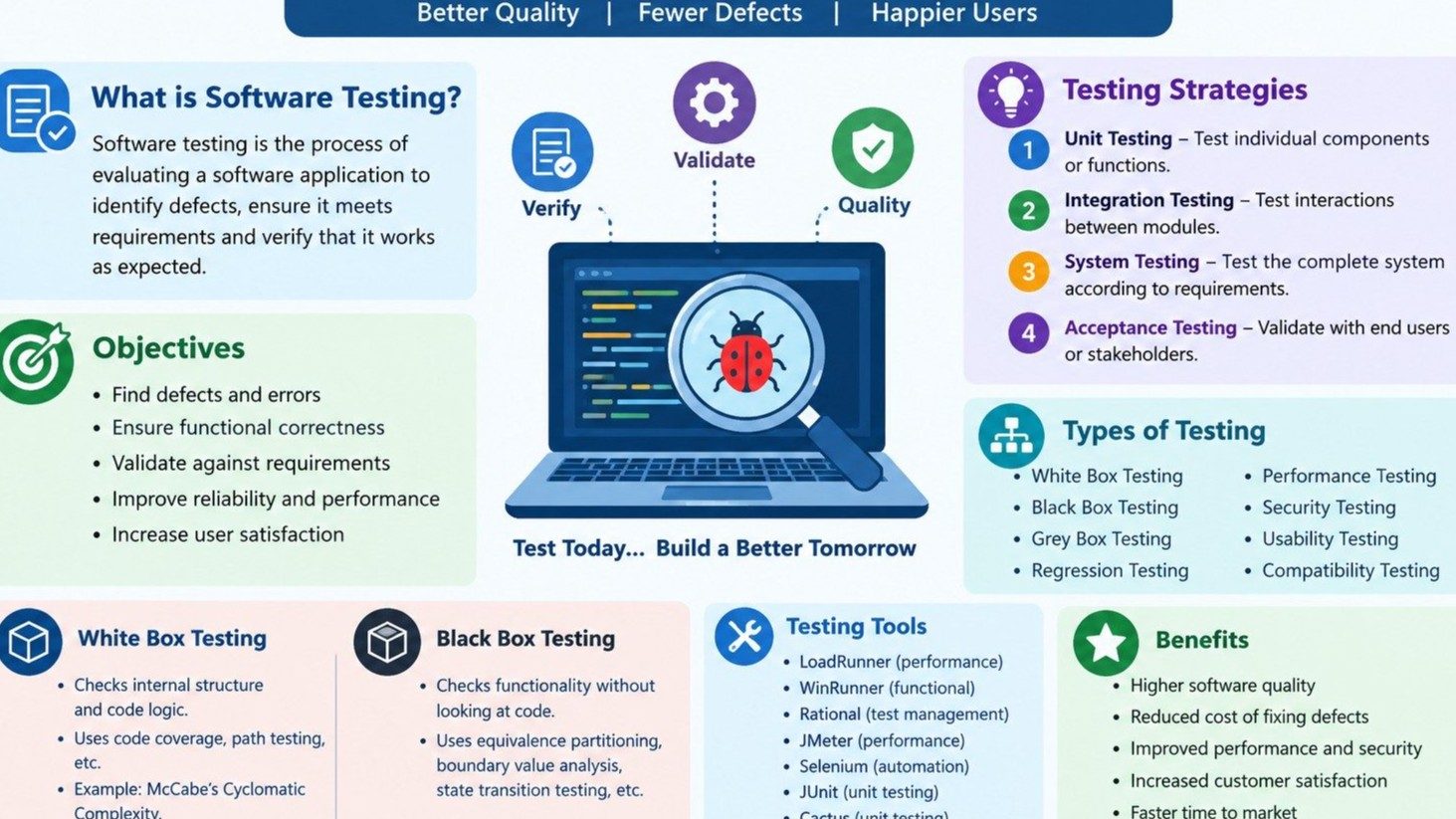
1. Introduction to Software Testing
Software testing is a systematic process of examining and evaluating a software product to determine whether it satisfies specified requirements and to identify defects, errors, failures, or deviations from expected behavior. Testing is an essential activity in the software development life cycle because software defects can result in incorrect results, security problems, system failures, financial losses, and user dissatisfaction. Testing does not merely mean executing a program and checking whether it runs; it involves planning, designing test cases, executing tests, analyzing results, documenting defects, and verifying that defects have been corrected.
The fundamental purpose of software testing is to provide confidence about the quality and reliability of software. Testing attempts to discover defects before the software is delivered to users. A good testing process begins during the early stages of software development and continues throughout the life cycle. Testing may be performed at different levels, including unit testing, integration testing, system testing, and acceptance testing.
2.Objectives of Software Testing
The primary objective of software testing is to identify defects in software before they cause problems in the operational environment. Testing helps determine whether the implemented software satisfies functional and non-functional requirements. It also provides information about software quality, reliability, performance, usability, security, and maintainability.
Another important objective is to demonstrate that the software behaves correctly under normal, abnormal, and boundary conditions. Testers should not only test valid inputs but should also deliberately provide invalid and unexpected inputs to determine whether the software handles them appropriately.
Major objectives include:
To detect errors and defects.
To verify compliance with requirements.
To validate the software against user expectations.
To identify missing functionality.
To verify correctness of calculations and data processing.
To evaluate reliability and robustness.
To identify boundary and exceptional-condition problems.
To provide information for quality improvement.
To reduce the risk of software failure.
To establish confidence in the software before release.
3. Software Testing Strategies
A software testing strategy is a planned approach that specifies
what will be tested, when it will be tested, how it will be tested, who will perform the testing, and which techniques and tools will be used
A testing strategy should be developed according to the nature, complexity, risk, and requirements of the software. A large safety-critical system requires a much more rigorous testing strategy than a small utility program.
A common strategy is to begin testing at the smallest software components and progressively move toward the complete system. This approach is called
incremental testing
. Unit testing is followed by integration testing, system testing, and acceptancetesting.
Typical testing strategy
Unit Testing → Integration Testing → System Testing → Acceptance Testing
At the unit-testing level, individual modules are tested independently. Integration testing examines interactions between modules. System testing evaluates the complete integrated system. Acceptance testing determines whether the system satisfies customer and business requirements.
A good testing strategy should also include regression testing. Whenever a modification is made to software, previously tested functionality should be retested to ensure that the modification has not introduced new defects.
Original on Media.com



Comments
Sign in to join the discussion.
Sign in