

Article
Why Do Automotive Parts Factories Need So Many Different Types of Storage Racks?

If you ever visit an automotive parts factory, you may notice something interesting.
Some storage racks are tall and long, some look like large metal cages, some consist of just four upright posts, while others are specially designed for storing tires.
They are all used for storing products, so why do they come in so many different designs?
The truth is that each of these seemingly unusual steel racks serves a specific purpose.
Today, let's take a closer look at some common specialized storage racks used in automotive parts factories.
01 | Tire Storage Racks: Why Are Special Racks Needed for Tires?
Tires are among the most common products in the automotive industry.
However, when large quantities of tires need to be stored, ordinary flat pallets may not always be the most suitable solution.
Because of their round shape, tire storage requires careful consideration of space utilization, storage stability, and ease of handling.
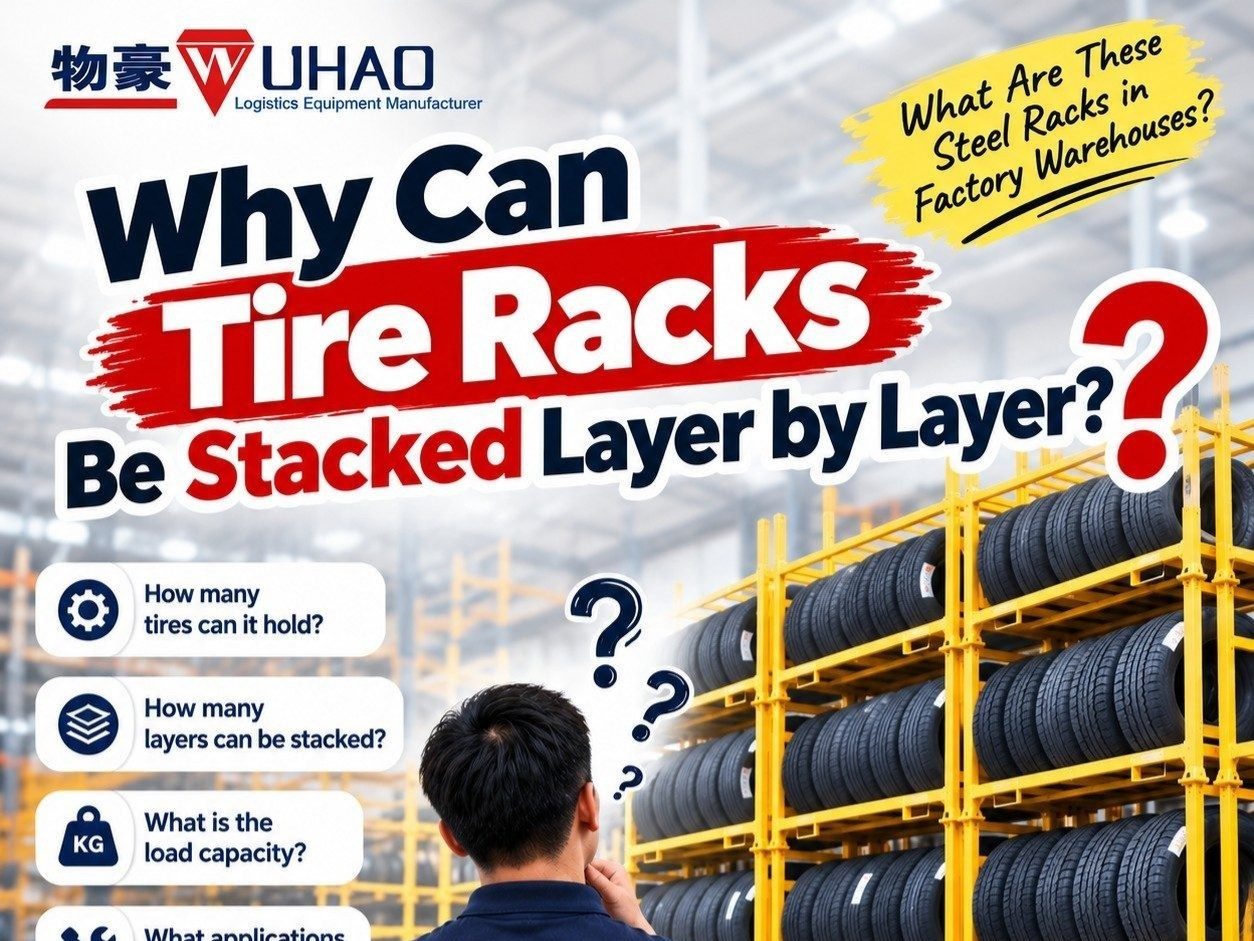
That's why specially designed steel tire storage racks are used in many warehouse applications.
[Image: Industrial steel tire storage rack]
These racks typically feature a steel frame structure with strategically positioned supports, allowing tires to be organized neatly for easier sorting, counting, and handling.
Some tire racks are also designed to be stackable, helping businesses make better use of vertical warehouse space.
Of course, whether tires should be stored vertically or horizontally depends on factors such as tire type, whether they are mounted on rims, storage duration, and applicable storage requirements. Not all tires are suitable for the same storage method.
The value of a dedicated tire rack goes beyond simply holding tires. It helps businesses keep large quantities of tires organized and easier to manage.
02 | Four-Post Storage Racks: Why Do They Have Only Four Posts?
Some steel storage racks have a surprisingly simple appearance.
They consist of a metal pallet base with four upright posts installed at the corners, without mesh panels or enclosed side walls.
At first glance, you might even wonder whether something is missing.
In fact, these products are commonly known as four-post stacking racks or post pallet racks.
Their main purpose is to use the four corner posts to provide support and positioning for stacking.
For goods suitable for open storage, this design reduces unnecessary side obstructions and makes loading and unloading more convenient.
Some models also feature removable posts.
When the racks are not in use, the posts can be removed to reduce the space occupied by empty racks, making storage and transportation more convenient.
However, open-frame racks are not suitable for every type of product. Whether additional panels, restraints, or positioning features are required depends on the actual application.
Although the design looks simple, the four posts play important roles in supporting, positioning, and stacking the rack.
For example, at Xiamen WUHAO, we work with various types of steel storage racks. Although four-post designs may look simple, their development requires careful consideration of load weight, stacking methods, and forklift handling requirements. Key structural details, including the base frame, post connections, and positioning features, must be properly designed.
Some customers also choose detachable structures to make empty rack storage and transportation more flexible.
03 | Wire Mesh Storage Cages: Why Do Some Products Need Enclosed Storage?
In automotive parts manufacturing, factories handle more than just tires and large components. They also deal with numerous small parts of different shapes and sizes.
These may include hardware components, connectors, and other small industrial parts that need to be stored together.
If these items are placed directly on ordinary pallets, they may become scattered, mixed together, or difficult to handle.
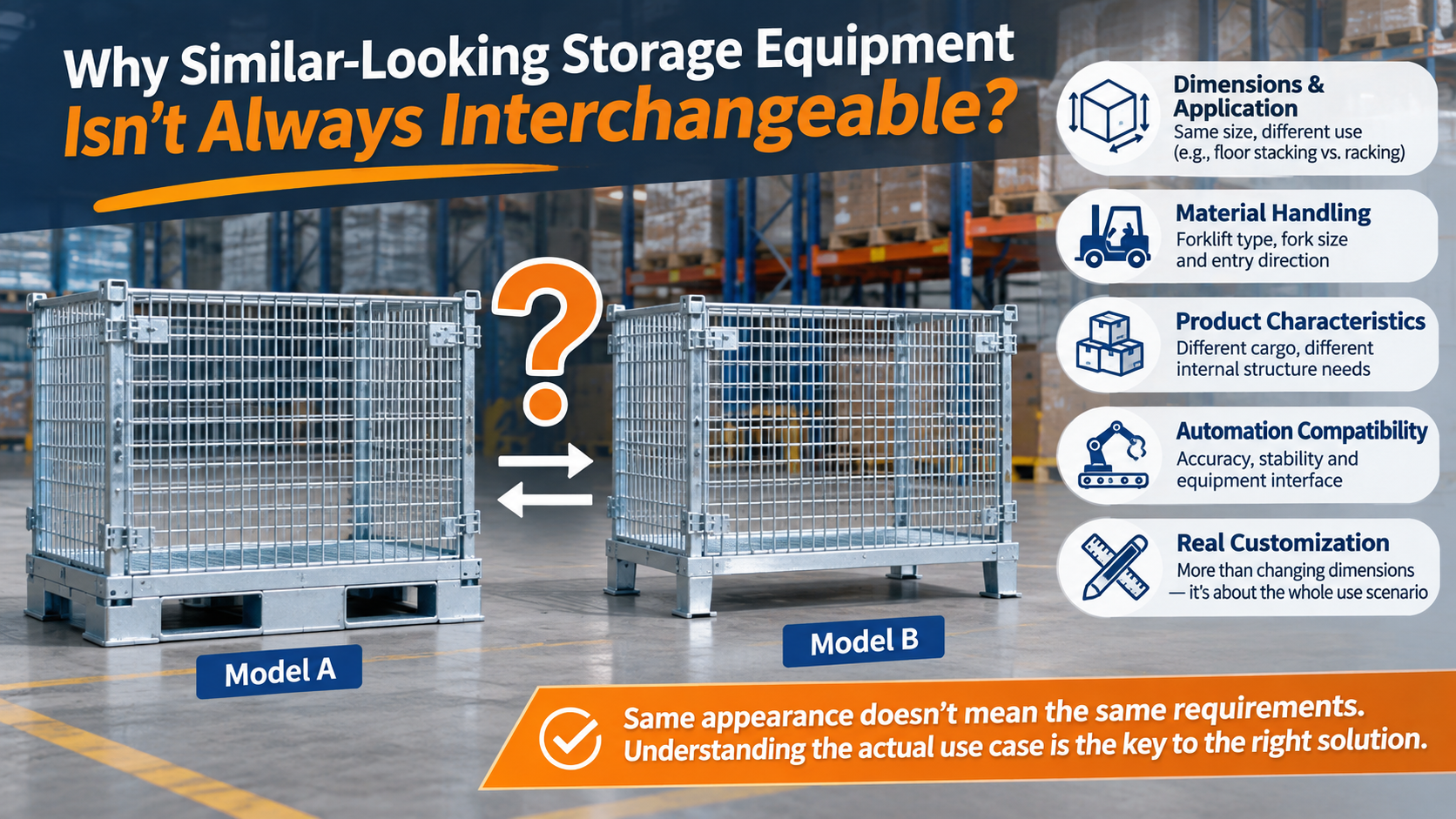
That's why many factories use metal wire mesh storage cages.
[Image: Industrial steel wire mesh storage cage]
These cages typically feature a steel frame combined with metal mesh panels, creating an enclosed structure that keeps goods organized and contained.
Some models are also equipped with access doors, making it easier for workers to load and retrieve materials.
For goods that need to move repeatedly between production areas, warehouses, and logistics operations, wire mesh storage cages are a practical and widely used solution.
For very small components, however, the mesh opening size must also be considered. Inner liners or storage bins may be needed to prevent small items from falling through.
The purpose of a wire mesh storage cage is not simply to store goods, but to make parts handling and material circulation more organized and efficient.
04 | Custom Turnover Racks: Why Do Some Racks Have Such Complex Structures?
While the previous rack types are relatively common, some specialized automotive parts turnover racks have much more unusual designs.
Some feature multiple levels of internal supports.
Others include positioning bars and restraining devices.
Some are even designed with dedicated holding positions based on the specific shape of the components.
Why do these racks need such complicated structures?
The reason is simple: automotive components vary greatly in shape, size, and handling requirements.
For example, some long metal components require multiple support points.
Parts with delicate surfaces may need protective structures to prevent contact or damage during transportation.
Other irregularly shaped products may require specially designed positioning features to keep them stable.
In these situations, ordinary wire mesh cages or flat pallets may not be suitable.
Manufacturers therefore need to consider component dimensions, weight, contact areas, and handling methods when developing dedicated storage racks.
These unusual-looking structures are usually designed to meet the specific requirements of the products being handled, rather than simply to make the racks look different.
At WUHAO, these details are also an important part of our daily product design and manufacturing work.
For different types of industrial components, we look beyond load capacity. We also need to understand product dimensions, contact points, and actual handling conditions.
Only by understanding the real application requirements can we determine whether a standard design is suitable or whether a customized solution is needed.
05 | Why Is Material Handling So Important in Automotive Parts Factories?
Storage equipment in automotive parts factories is not used only for storing products.
In many cases, components go through several stages from production to the next manufacturing process.
For example:
After production, components are placed in turnover racks.
They are then transferred to temporary storage areas by forklifts or other handling equipment.
According to production schedules, they are subsequently delivered to assembly stations or prepared for packaging and transportation.
Throughout this process, the same rack may be used repeatedly.
Therefore, rack design needs to consider more than just how much it can hold.
Loading and unloading convenience, handling stability, compatibility with on-site equipment, and empty rack storage are also important factors.
For racks designed for long-term repeated use, structural strength, dimensional consistency, and ease of maintenance are equally important.
A well-designed turnover rack should support the entire material handling process, rather than simply meet the requirements of one storage stage.
[Image: Industrial material handling and warehouse storage racks]
06 | Why Can't One Type of Storage Rack Solve Every Problem?
Since these are all steel storage products, why not use just one type of rack for everything?
From a management perspective, standardization certainly has its advantages.
Using consistent specifications can simplify purchasing, inventory management, and compatibility with certain material handling equipment.
However, different components vary in dimensions, weight, shape, and handling requirements.
If actual application needs are ignored in favor of standardization, businesses may end up with wasted storage space, inconvenient loading and unloading, or inadequate load restraint.
Therefore, it is often best to start by considering proven standard products.
When standard products cannot meet the actual requirements, structural modifications or customized designs can be developed according to the specific application.
Standardization and customization are not contradictory. The key is finding the right solution for the actual operating conditions.
Final Thoughts
Storage racks in automotive parts factories come in many different shapes and designs. Some may even look unusual at first glance.
But once you understand their applications, you will discover that each structure is designed to solve a particular problem.
Tire racks focus on efficient tire storage.
Four-post racks provide stacking support and improve space utilization.
Wire mesh storage cages help organize and handle industrial components.
Specialized turnover racks are designed around the shapes and handling requirements of specific products.
The best storage equipment is not necessarily the most complicated or the simplest. It is the one that best fits the actual application.
This is an important principle in warehouse and logistics equipment manufacturing: understand the products and operating environment first, then determine the right structural design.
At Xiamen WUHAO Industry & Trade Co., Ltd., we believe that warehouse and logistics equipment is about much more than simply welding steel into a frame. More importantly, it is about understanding customers' products and their actual operating requirements.
From wire mesh storage cages and steel pallets to customized industrial turnover racks, we are committed to providing practical structural designs that make storage and material handling more convenient and efficient.
This is Bunny Hu from WUHAO – Logistics & Warehousing.
Follow us for more insights into warehouse storage equipment, manufacturing experience, and practical material handling solutions.
More from WUHAO-Bunny
Original on Media.com



Comments
Sign in to join the discussion.
Sign in