

Article
Why Do Factories Use Stackable Steel Racks? A Practical Guide to Industrial Storage Solutions
Understanding the Uses and Selection of Steel Stacking Racks

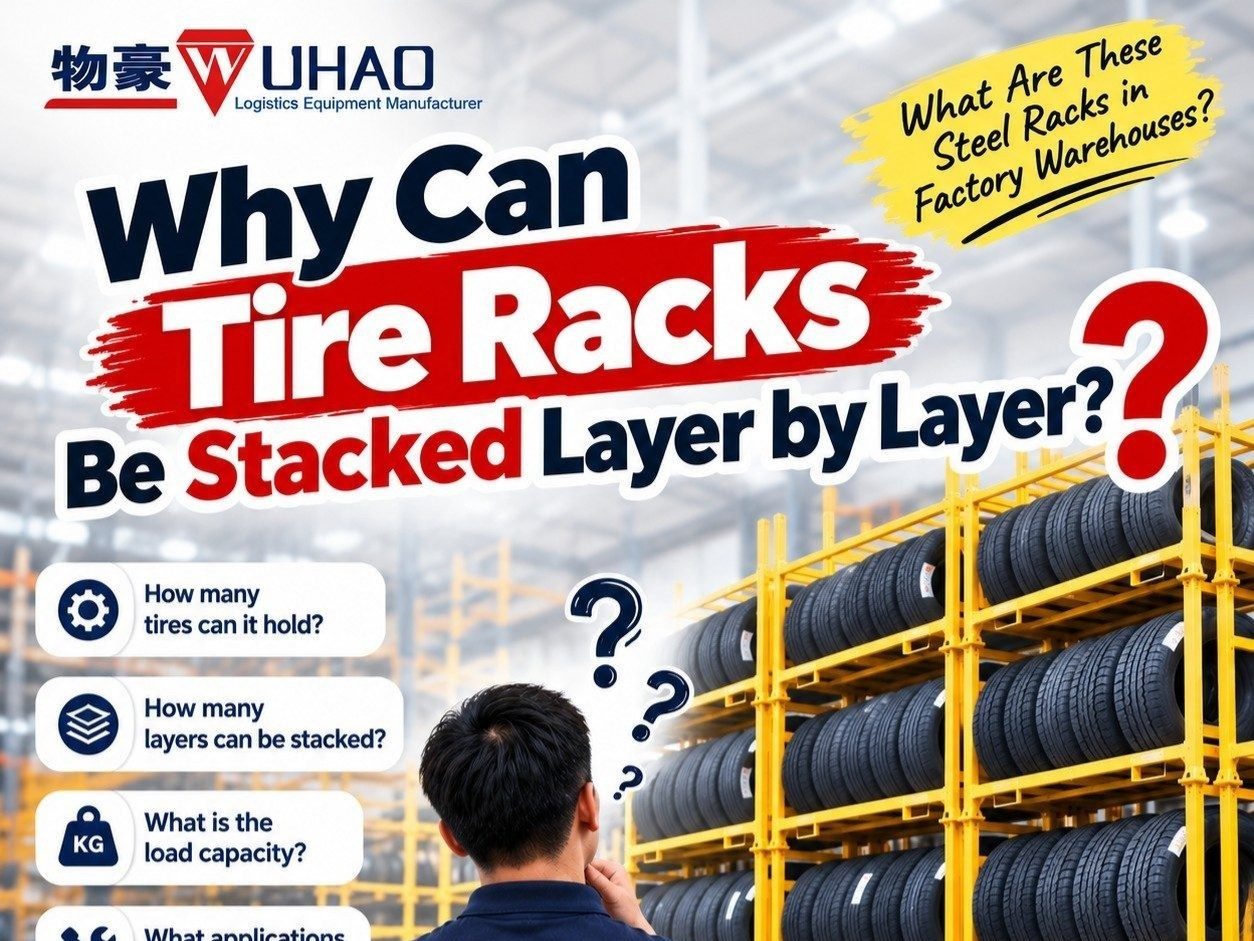
Walk into an automotive parts factory, a machinery manufacturing plant, or an industrial warehouse, and you may notice a common type of storage equipment.
These racks are usually made from steel tubes, structural steel sections, or other steel components. They look like simple metal frames, but they can hold everything from automotive parts and tires to heavy machinery components.
What makes them particularly interesting is that many of these racks can be stacked on top of one another.
At first glance, you might wonder:
Aren't these just ordinary steel frames? Why do factories invest in specialized storage racks?
In the material handling industry, this type of equipment is commonly known as a Stackable Steel Rack, sometimes also referred to as a Stacking Stillage.
Today, let's explore how these racks work, why they are widely used, and what businesses should consider before purchasing them.
1. What Is a Stackable Steel Rack?
Simply put, a stackable steel rack is an industrial storage solution designed to support goods and, through a suitable structural design, allow multiple loaded racks to be stacked vertically.
A typical stackable rack consists of:
A load-bearing base
Vertical support posts
Structural connections
Stacking and positioning features
Unlike conventional fixed warehouse racking systems, certain stackable steel racks can be moved and rearranged according to changing storage requirements.
Some models also feature detachable components, allowing the racks to be disassembled when not in use to reduce empty storage space.
However, not every steel storage rack is stackable, and not every stackable rack is detachable.
The actual functions depend on the product's structural design.
2. Why Do Factories Use Stackable Steel Racks?
2.1 Better Use of Vertical Warehouse Space
One of the most common challenges in industrial warehouses is limited floor space.
As inventory increases, storing everything directly on the floor becomes increasingly inefficient.
Stackable steel racks allow businesses to use vertical storage space more effectively, provided that the stacking arrangement meets the required safety and load-bearing conditions.
This can help reduce floor space occupied by stored goods and improve warehouse organization.
However, the maximum stacking height must always be determined according to rack capacity, load distribution, and actual operating conditions.
The goal is not simply to stack higher, but to store goods safely and efficiently.
2.2 Easier Forklift Handling and Material Movement
In manufacturing facilities, storage equipment must do more than hold products.
It should also support efficient material handling.
For example, automotive components may need to move through several stages, including production, temporary storage, inspection, and transportation.
With properly designed steel storage racks, goods can remain on the same rack throughout multiple handling processes.
This may reduce repeated loading and unloading.
However, the rack base, forklift entry points, fork spacing, and load-bearing structure must be compatible with the actual forklift equipment.
A good storage rack should not only hold products securely but also make everyday handling easier.
2.3 Suitable for Irregular Industrial Products
Standard cartons and conventional pallets work well for many regularly shaped products.
But industrial manufacturing often involves goods that are difficult to store using ordinary packaging.
Examples include:
Automotive tires
Metal stamping parts
Machinery components
Large or irregular industrial products
These items may require specially designed supports, positioning features, or protective structures.
This is why many manufacturers choose customized steel storage racks.
By designing the rack around the shape and handling requirements of the goods, businesses can improve storage organization and help reduce damage caused by unwanted movement during handling.
3. Stackable Steel Racks vs. Traditional Warehouse Racking
Both are widely used in industrial storage, but they serve different operational needs.
Traditional warehouse racking systems are generally installed in fixed locations. Goods are typically stored on pallets or other load carriers placed on the rack beams.
Stackable steel racks, depending on their design, can be moved together with the stored goods and stacked vertically without relying on a conventional fixed racking system.
For example:
A factory with a stable warehouse layout and consistent inventory may benefit from traditional pallet racking.
On the other hand, a manufacturing facility that frequently changes its storage layout or handles different batches of industrial components may benefit from movable stackable racks.
Neither solution is automatically better.
The right choice depends on the products, handling processes, and warehouse operating conditions.
4. Five Important Factors When Choosing Stackable Steel Racks
When sourcing industrial storage racks, many buyers start with a simple question:
"How much does each rack cost?"
Price is certainly important.
However, for customized industrial racks, dimensions and unit price alone are not enough to determine whether a product is suitable.
Here are five important factors to consider.
4.1 Load Capacity
First, determine the actual weight each rack needs to support.
It is also important to understand how the weight will be distributed.
For example, a uniformly distributed 1,000 kg load and a concentrated 1,000 kg load can create very different structural requirements.
The base design, support points, and overall rack structure should be evaluated accordingly.
4.2 Stacking Height and Stability
If the racks need to be stacked, confirm the maximum permitted stacking levels and the stability of the structure under loaded conditions.
Pay particular attention to the vertical posts, stacking interfaces, and connection points.
Never assume that a rack can be stacked higher simply because it appears strong.
4.3 Forklift Compatibility
Before purchasing, confirm whether the rack supports two-way or four-way forklift entry.
The base should provide suitable clearance and fork entry dimensions for the equipment used on site.
For warehouses with frequent material movement, these details can significantly affect daily handling efficiency.
4.4 Detachable or Fixed Structure
If empty racks need to be transported or returned regularly, a detachable design may be worth considering.
For example, some post pallet racks feature removable vertical posts that can be taken out when the racks are empty.
This can make empty rack storage and transportation more convenient.
However, if the racks will remain in the same location for long periods, a detachable structure may not be necessary.
4.5 Surface Treatment
Common surface treatments for steel storage racks include:
Powder coating
Spray painting
Galvanizing
Each option has different characteristics in terms of appearance, cost, and corrosion resistance.
The most suitable treatment depends on the operating environment, humidity, maintenance requirements, and budget.
5. Does More Steel Always Mean a Better Rack?
This is a common misconception.
Some buyers believe that thicker steel and heavier racks automatically mean better quality.
But that is not always true.
The load-bearing performance of a steel rack depends on several factors, including:
Material specifications
Structural design
Load distribution
Welding quality
Connection methods
Even a rack made from relatively thick steel may not perform as expected if the structural design is unsuitable.
On the other hand, a well-engineered design may achieve the required strength and safety performance while controlling overall weight and manufacturing costs.
Therefore, buyers should evaluate the complete structure rather than comparing material thickness alone.
A heavier rack is not necessarily a better rack. The right design matters more.
6. When Should You Consider Custom Steel Storage Racks?
For standard, regularly shaped goods, off-the-shelf storage equipment may already meet your needs.
However, customized steel racks can be a better option when:
Products have unusual dimensions or shapes.
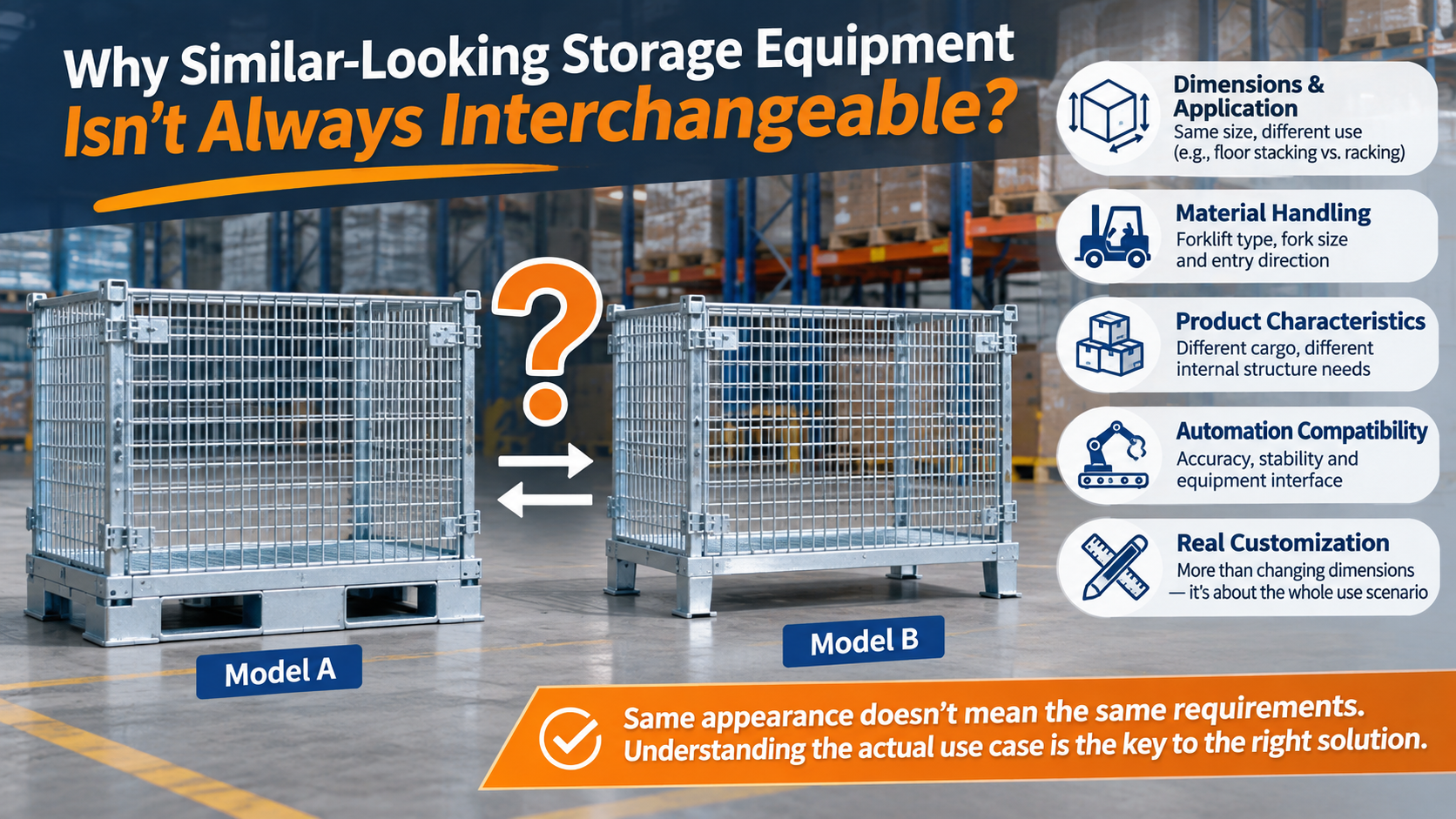
Racks must work with existing forklifts, warehouse racking, or automated systems.
Specific load capacities or stacking heights are required.
Additional positioning, protection, or securing features are needed.
Empty rack storage and return transportation need to be optimized.
Customization is not simply about changing the length, width, or height of a rack.
It involves adapting the structure to the products, handling equipment, and actual warehouse environment.
A rack designed for the real application is often more valuable than one selected only by its specifications.
Final Thoughts
Stackable steel racks may look like simple metal frames, but their actual performance depends on much more than appearance.
Load capacity, stacking stability, forklift compatibility, storage efficiency, and long-term durability all play important roles.
For businesses purchasing industrial storage equipment, the most effective approach is to start with three questions:
What are you storing? How will it be handled? How will it be stored?
Once these requirements are clear, it becomes much easier to determine whether a standard product or a customized solution is more appropriate.
At WUHAO, we specialize in the design and manufacturing of industrial material handling equipment and customized steel storage solutions.
With manufacturing experience dating back to 2007, we provide OEM and ODM services to support different warehouse storage and material handling requirements.
What type of storage system does your facility use — traditional fixed racking or movable stackable steel racks?
We'd love to hear your experience.
WUHAO | Xiamen Wuhao Industry & Trade Co., Ltd.
Industrial Storage & Material Handling Equipment Manufacturer
More from WUHAO-Bunny
Original on Media.com



Comments
Sign in to join the discussion.
Sign in