

Article
Why Similar-Looking Storage Equipment Isn't Always Interchangeable

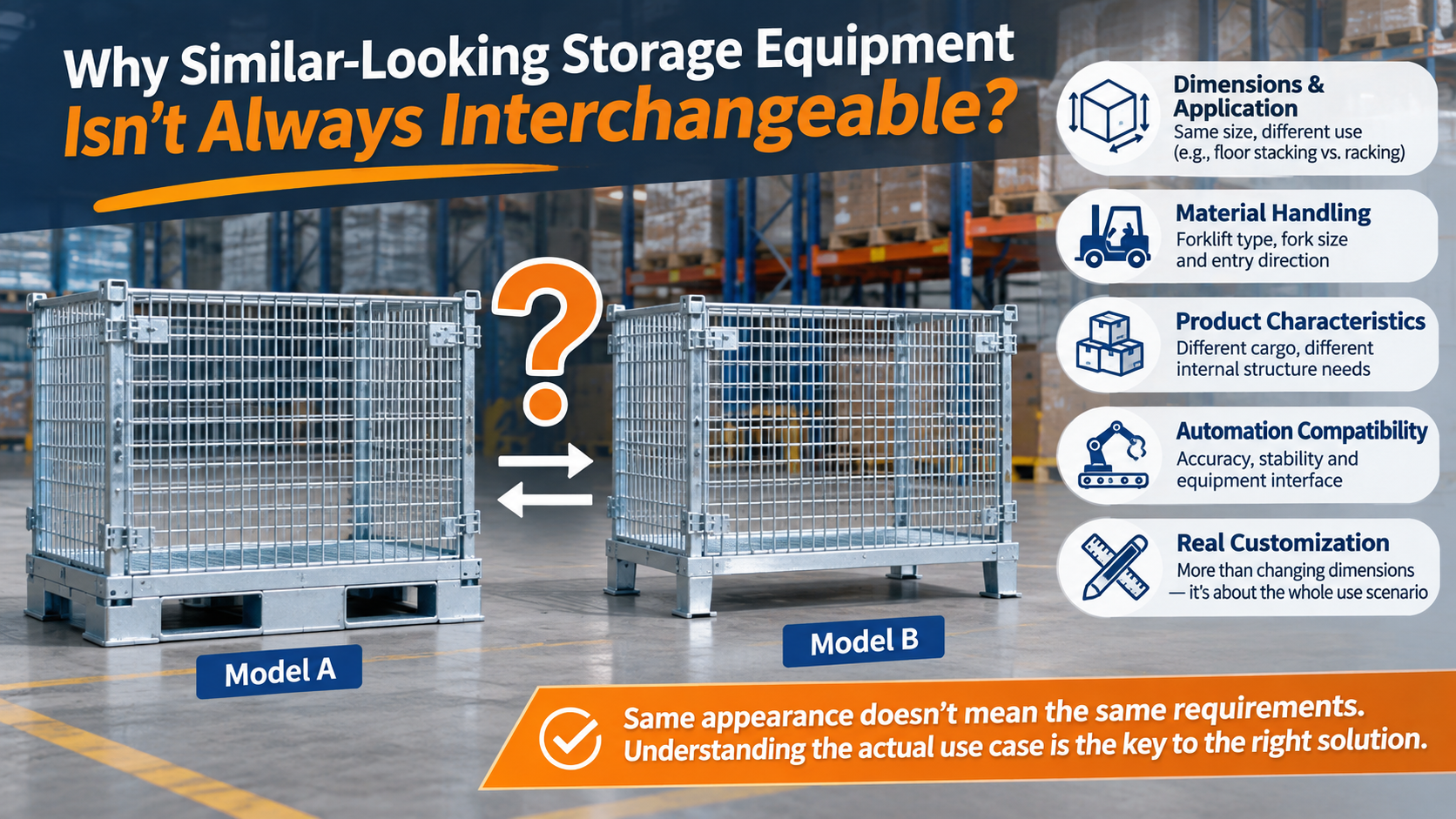
n the warehousing and logistics equipment industry, we often encounter a familiar situation:
A customer sends us a product photo and asks:
"Can you manufacture something like this?"
At first glance, it may look like a simple steel frame or a wire mesh container.
However, once we learn more about the actual application, we often discover something important:
Products that look almost identical may have completely different requirements in real-world use.
01 | Same Dimensions Don't Always Mean the Same Application
Imagine two steel pallets with exactly the same length, width, and height.
One is designed for floor stacking, while the other is intended for use in warehouse racking systems.
Although their overall dimensions are identical, the positions of their bottom supports may be different.
If the bottom structure does not properly align with the rack beams, the pallet may not be suitable for safe storage, even if it has sufficient load capacity.
That's why selecting storage equipment involves more than simply checking its external dimensions.
It is equally important to understand where the equipment will be used and how it will be operated.
02 | Forklift-Compatible Doesn't Mean Compatible with Every Forklift
Some steel stillages and storage containers are designed with forklift entry points.
However, not every factory uses the same type of forklift.
Fork length, fork width, fork spacing, and entry direction can all affect actual handling operations.
For example, a container originally designed for four-way forklift entry may no longer suit the warehouse layout if it is replaced with a two-way entry design.
This is why, when developing customized material handling equipment, we usually need to understand what type of handling equipment the customer uses.
Being able to lift a container and being able to handle it safely and efficiently are two different things.
03 | Different Products May Require Different Internal Structures
Consider two wire mesh containers of the same size.
One is used to store cardboard boxes, while the other is designed for metal components.
Even if their total load weights are similar, the shape of the goods, weight distribution, and contact points may be completely different.
Some applications require additional bottom supports.
Others may need internal dividers, positioning fixtures, or protective structures to prevent movement during transportation.
Simply copying an existing design without considering these differences may lead to inconvenient loading, unstable cargo, or uneven load distribution.
Therefore, understanding the characteristics of the goods being stored or transported is an essential part of storage equipment design.
04 | Suitable for Conventional Warehouses Doesn't Mean Suitable for Automated Warehouses
As warehouse automation continues to develop, more companies are introducing automated storage and retrieval systems (AS/RS), conveyor systems, and automated material handling equipment.
In conventional warehouses, forklift operators can visually check and adjust their positioning during handling.
Automated systems, however, typically operate according to predefined dimensions, positions, and operating programs.
If a container has excessive dimensional deviations or its bottom support structure is incompatible with the handling system, automated loading, unloading, and transportation may be affected.
Therefore, steel containers designed for automated warehouses often require greater attention to:
Dimensional accuracy and tolerances
Structural stability
Compatibility with automated handling equipment
Automated warehousing requires more than strong containers. It requires consistent, accurate positioning and reliable handling every time.
05 | True Customization Is More Than Changing Dimensions
Many people assume that customized storage equipment simply means providing dimensions and asking a manufacturer to produce accordingly.
In reality, the process is often much more complex.
Before designing and manufacturing a storage container, several important questions need to be considered:
What types of goods will be stored, and how much do they weigh?
Will the equipment be handled by forklifts or automated systems?
Does it need to be stackable? If so, how many levels?
Will it be used in warehouse racking systems?
Will it undergo frequent transportation and repeated handling?
Only after understanding these requirements can a manufacturer determine whether an existing product can be used directly or whether structural modifications are necessary.
Final Thoughts
Storage equipment may appear simple, but a truly practical and reliable solution often requires careful consideration of actual operating conditions.
Similar appearances do not mean identical application requirements. The same dimensions do not necessarily make two products interchangeable.
For purchasing professionals, clearly communicating the intended application in advance can help reduce unnecessary modifications, delays, and communication costs.
For manufacturers, understanding customers' actual needs is far more valuable than simply reproducing a product based on a photograph.
This is Hu from Warehouse & Logistics with Hu, sharing practical insights into warehouse equipment, factory manufacturing, and industrial material handling.
Stay tuned for more industry knowledge and real-world manufacturing experience!
More from WUHAO-Bunny
Original on Media.com



Comments
Sign in to join the discussion.
Sign in