

Article
Why Are There Always So Many “Iron Baskets” in Factory Warehouses? A Primer on Industrial Wire Mesh Containers and Selection Pitfalls

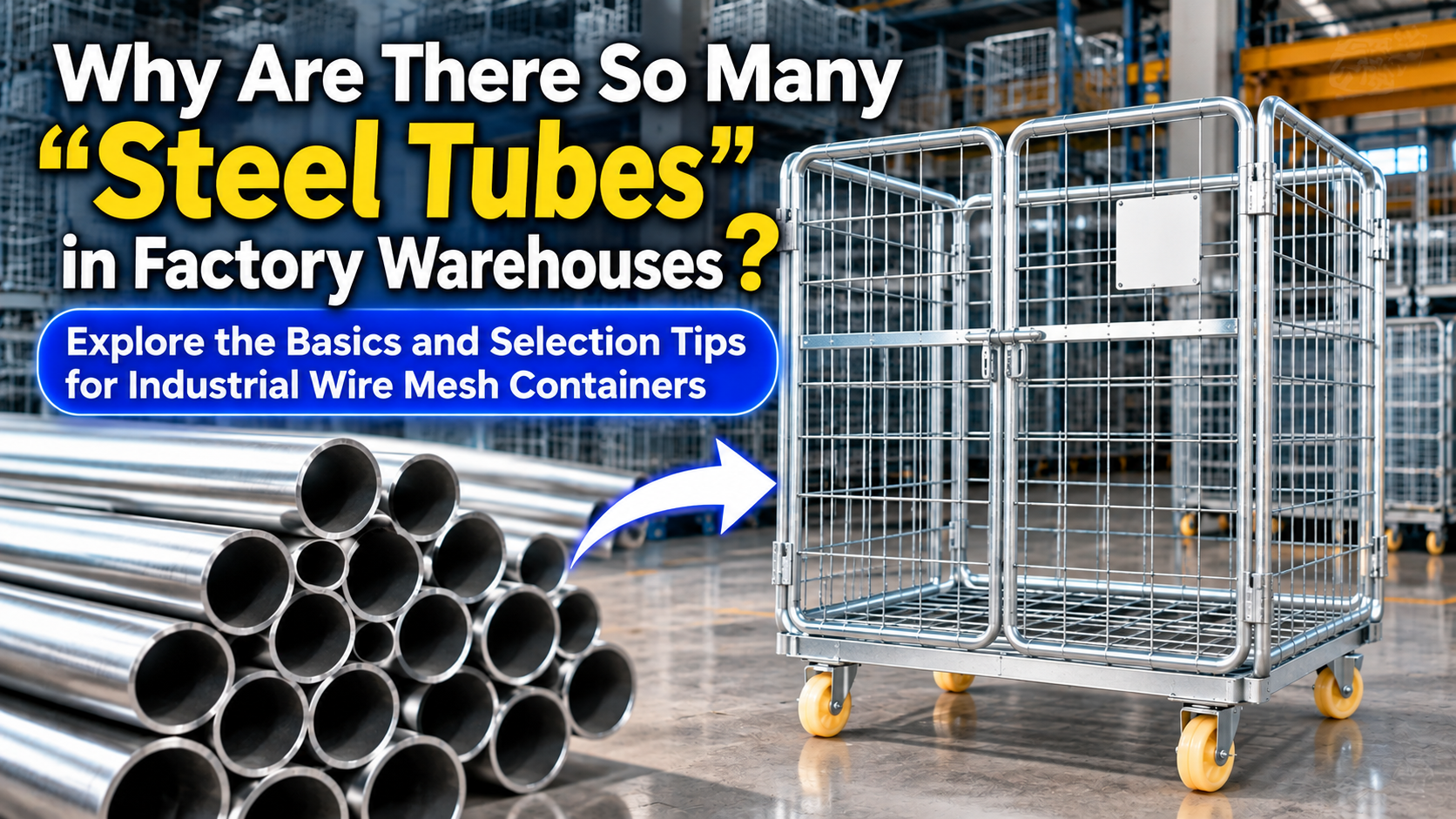
If you have ever visited an auto parts factory, a machining plant, a third-party warehouse, or an e-commerce sorting center, you have probably seen a square container welded together from steel wire. Outsiders call it an “iron basket.” In the industry, it is usually called a storage cage, metal mesh container, wire mesh container, or returnable parts bin.
It does not look very technical, but in industrial logistics it is actually a critical “standard logistics unit.” Today, let’s look at it from an industry perspective: how should industrial wire mesh containers be selected, and why do some last ten years without deforming while others are scrapped within six months?
1. It Is Not Just a Box—It Is a Stackable Logistics Unit
The core value of an industrial wire mesh container is not simply “holding things.” It is turning materials into units that can be counted, stacked, and circulated.
It usually needs to work with pallets, racks, forklifts, transfer carts, and AGVs. Common designs include stacking feet, forklift slots, reinforced bottom beams, and half-drop or full-drop gates. Once stacked, floor space is used vertically, effectively creating a simple racking system.
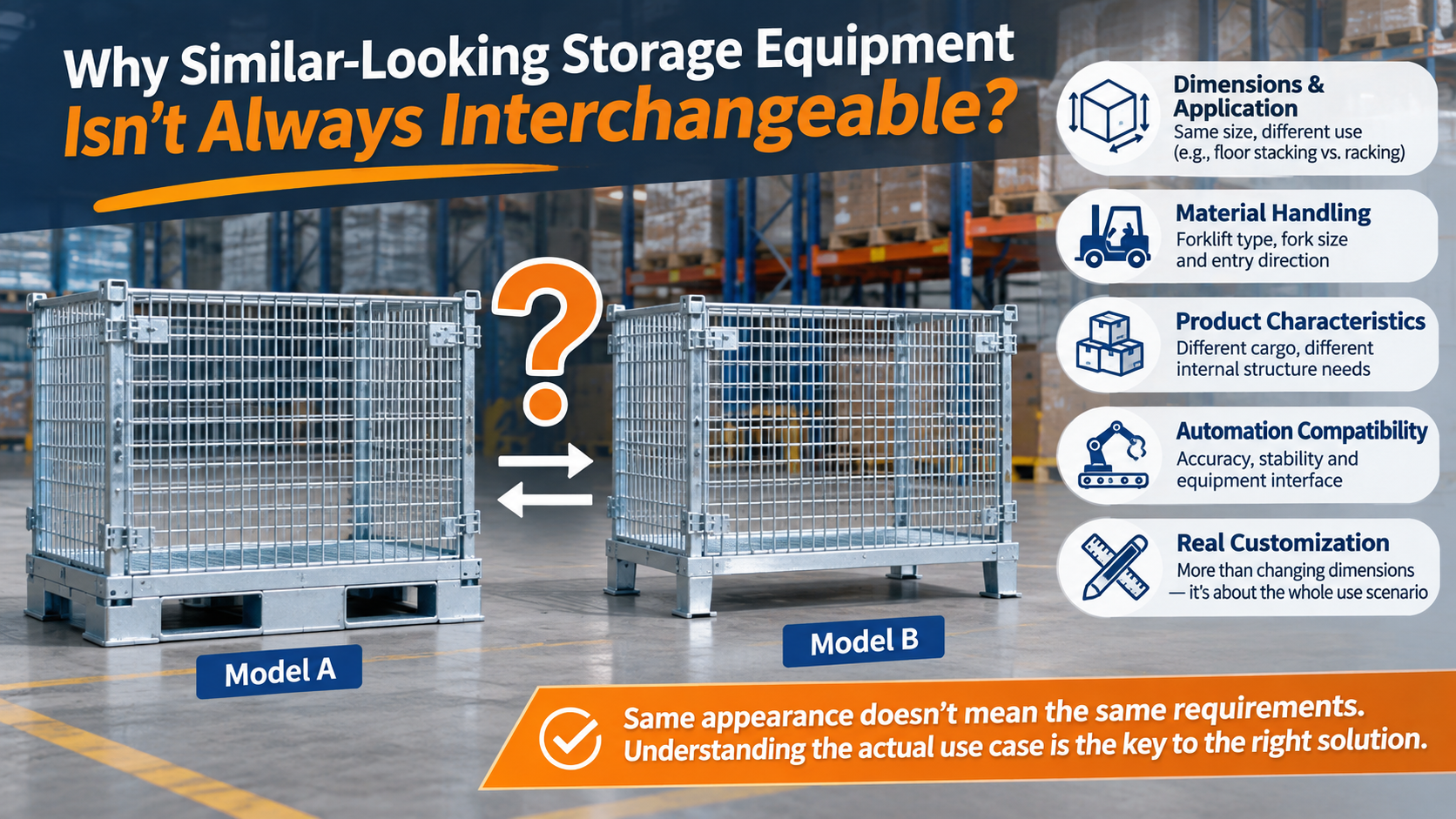
So when selecting a container, do not only look at length, width, and height. You also need to consider how it will be moved, stacked, and stored.
2. Structure Determines Service Life: Focus on Wire Diameter, Welds, Base Frame, and Surface Treatment
Two wire mesh containers may look similar, but their service lives can differ enormously. The key points are:
Wire diameter
Common options include 4.0 mm, 5.0 mm, 6.0 mm, and so on. The thicker the wire, the better the impact resistance and load capacity, but the weight and cost also increase.Mesh spacing
Mesh spacing determines whether small parts will fall through. When storing screws or small stamped parts, mesh that is too open can be a real problem. In such cases, PP sheets or liners may be needed.Base frame structure
The bottom is often the key to load-bearing performance. The layout of U-channel steel, rectangular tubes, and reinforcing ribs directly affects static and dynamic load capacity.Weld quality
Incomplete or missed welds are a major cause of early failure. In industrial applications, weld strength matters more than appearance.Surface treatment
Cold galvanizing, hot-dip galvanizing, and powder coating each have their own applications. Hot-dip galvanizing offers stronger rust protection and is suitable for humid or outdoor environments. Powder coating makes color-based management convenient and is suitable for workshop zoning.
3. Why Do Many Factories Switch from Plastic Bins and Wooden Boxes to Metal Mesh Containers?
Plastic returnable bins are light and clean, making them suitable for light loads and clean environments. However, in heavy-load, oily, high-temperature, and frequently forklift-handled scenarios, plastic bins deform and age easily.
Wooden boxes are cheap, but they have a short service life, shed debris easily, and are sensitive to moisture. They are also restricted in export or high-cleanliness scenarios.
The advantages of metal mesh containers are high load capacity, breathability and visibility, resistance to oil and dirt, repairability, and stackability. Especially for mechanical parts, castings, auto parts, and hardware items, metal mesh containers are often more suitable.
4. When Selecting a Container, Do Not Just Ask “How Much?” Ask Five Questions First
When purchasing industrial wire mesh containers, it is advisable to confirm the following first:
What will it hold? What is the weight per piece, total weight, and are there sharp edges or corners?
What is the static load? Dynamic load? Stacking load?
How many layers will be stacked? Is the bottom layer strong enough to bear the pressure?
Does it need to be foldable? Does it need wheels? Will forklifts be used?
Is the environment humid, outdoors, a cold storage area, or high-temperature?
A special reminder: Static load, dynamic load, and stacking load are three different concepts.
Static load means the container is sitting still on the ground. Dynamic load means it is being moved by a forklift. Stacking load is the weight borne by the bottom container in a stack. Many buyers only ask “What is the load capacity?” and then use a static-load rating as a dynamic-load rating. The container quickly deforms as a result.
5. A Few Small Industry Trends
Industrial wire mesh containers are also evolving:
Foldable designs reduce the cost of return transport when empty;
Denser mesh plus liners balance small-part containment;
Label holders and color coding make inventory counting and zoning easier;
Caster-mounted containers support line-side delivery in lean production;
Integration with AGVs, automated storage and retrieval systems, and pallet systems is making them part of smart logistics.
6. Maintenance and Safety Should Not Be Ignored
Metal mesh containers are not buy-and-forget items. Regularly inspect welds, feet, and mesh surfaces for deformation. Avoid off-center loading and overloading. Do not force high stacks on uneven floors. Many accidents are not caused by container quality problems, but by improper use.
Final Thoughts
The value of an industrial wire mesh container is not that it is “cheap.” It is that it turns warehousing from clutter into standardized, stackable, and circulating logistics units. Choose the right one, and warehouse efficiency, inventory counting speed, and transport safety all improve. Choose the wrong one, and you end up with a pile of space-consuming, easily deformed metal frames.
Disclosure: I work in the industrial metal storage equipment industry. If you are selecting storage cages, wire mesh containers, or returnable parts bins, feel free to share your dimensions, load requirements, and use scenario. Selection matters more than simply comparing prices.
More from WUHAO-Bunny
Original on Media.com



Comments
Sign in to join the discussion.
Sign in