

Article
Bending Process: A Key Step in Ensuring Structural Accuracy of Metal Products
Bending is a critical process in metal fabrication, directly affecting product accuracy, structural strength, and consistency. This article explains how proper bending improves the quality of steel pallets, storage cages, stacking racks, and other customized material handling products, while helping

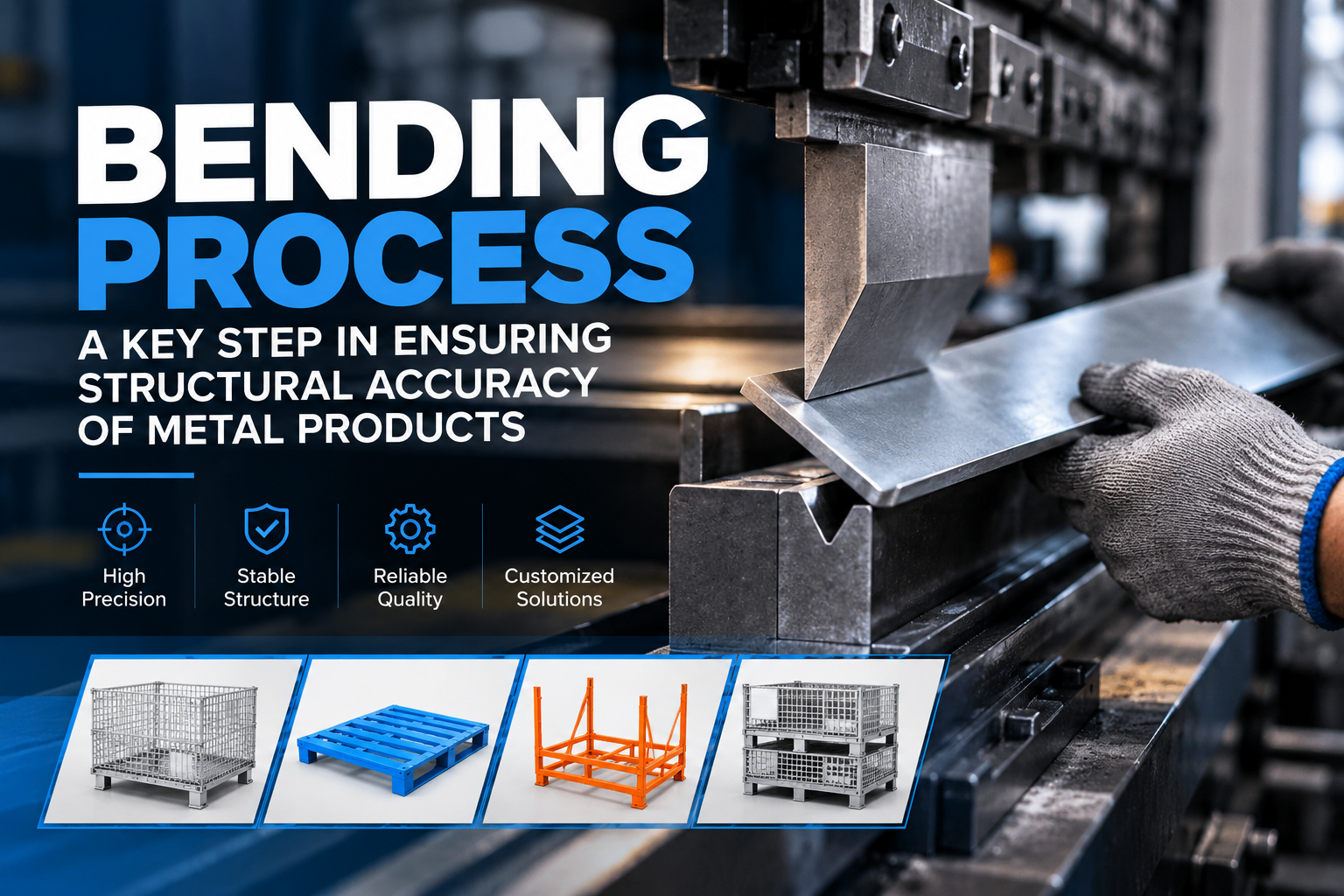
In the manufacturing of metal storage and material handling equipment, bending is a critical production process. Whether it is a steel pallet, storage cage, stacking rack, or other customized metal handling equipment, many structural components need to be formed through bending in order to achieve the required dimensions, angles, and structural strength.
At first glance, bending may seem like simply shaping a flat metal sheet into a desired form. In actual production, however, it requires precise equipment, proper tooling, a good understanding of material properties, and experienced operation.
What Is the Bending Process?
Bending is a metal forming process in which pressure is applied to sheet metal using bending equipment and dies, causing controlled plastic deformation according to the design requirements.
Through bending, flat steel sheets can be formed into channels, L-shaped sections, U-shaped sections, and various other structural profiles. These parts then provide the foundation for subsequent welding, assembly, and final product fabrication.
For storage and material handling equipment, a well-designed bent structure can not only reduce the number of individual components, but also improve the overall strength and stability of the product.
Why Is Bending Accuracy Important?
Industrial products are often assembled from multiple components. If the bending angle, position, or dimensions are inaccurate, problems may occur during welding and assembly, such as misaligned holes, structural deviation, or uneven gaps.
For products that need to be stacked, folded, or handled by forklift, dimensional accuracy has a direct impact on actual performance and usability.
During the bending process, key factors must therefore be carefully controlled according to the product drawings, including:
sheet thickness, bending angle, bending position, bending radius, and the final formed dimensions.
Only when each production step remains stable can good consistency be maintained across batch production.
How Bending Affects Product Strength
A properly designed bending structure can reduce the number of welds while improving the overall strength of the component.
For example, some structures that would otherwise require several separate parts to be welded together can instead be formed from a single sheet through bending. This reduces the number of weld joints and can also lower the risk of weld failure under long-term loading.
For steel pallets, metal containers, storage cages, stacking racks, and similar products, a well-designed bending structure can further improve load stability and service life.
Stable Processes Ensure Consistency in Batch Production
For B2B customers purchasing in volume, producing one good sample is not enough. What really matters is whether the dimensions, structure, and quality can remain consistent across dozens, hundreds, or even larger production batches.
Stable bending processes are therefore an important foundation for maintaining consistent product quality in mass production.
At Xiamen Wuhao Industry & Trade Co., Ltd., we control key manufacturing processes according to product structures and approved drawings, including material cutting, bending, welding, and assembly, providing a reliable production foundation for steel pallets, storage cages, stacking racks, and various customized metal material handling products.
A reliable metal product is rarely determined by a single process. It comes from careful control of every manufacturing detail.
From a flat steel sheet to a complete material handling product, bending is only one step—but it is one of the key steps that determines structural accuracy.
More from WUHAO-Bunny
Original on Media.com



Comments
Sign in to join the discussion.
Sign in